
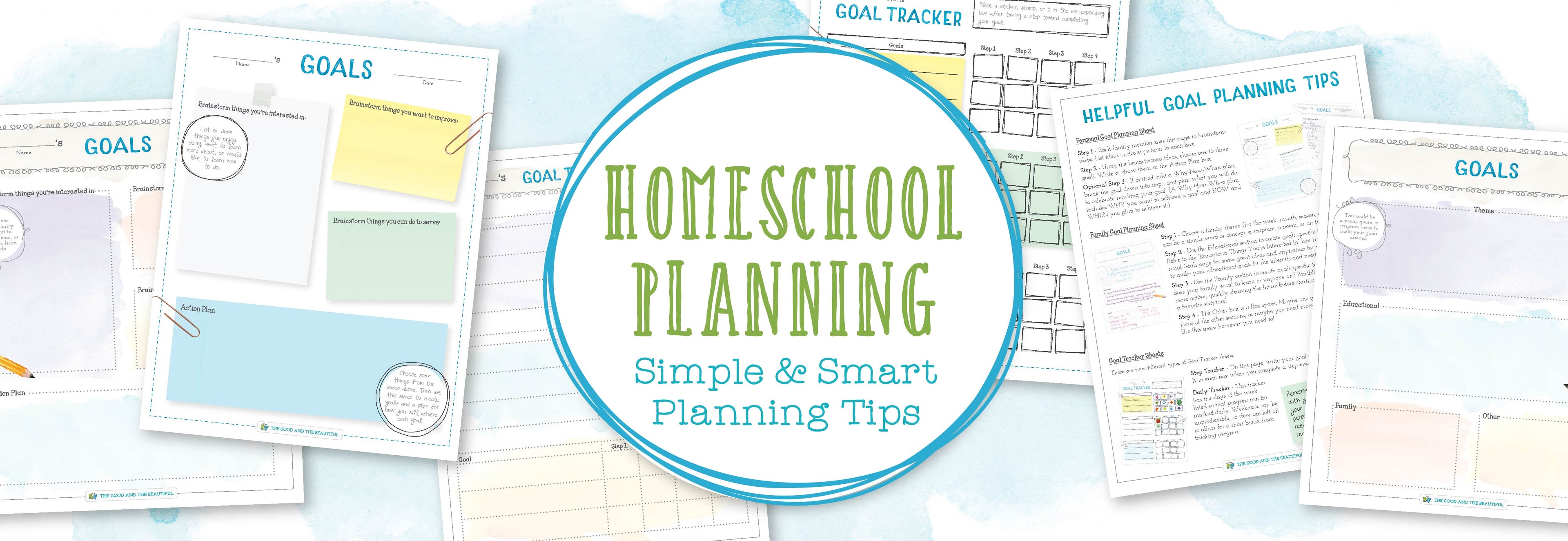

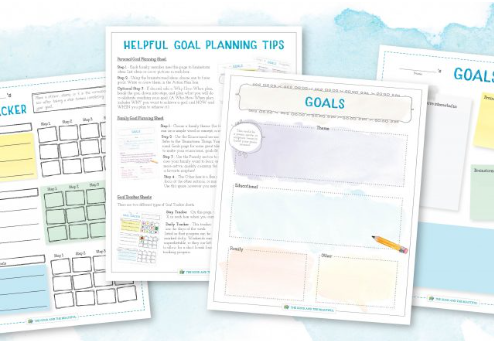
Be sure to download our free homeschool goal-setting pages below, which offer additional tips about setting and tracking goals.
2. Which homeschool philosophy should I use?
Common Homeschooling Philosophies
- Charlotte Mason — uses living books and a deep study of nature to facilitate learning.
- Classical — follows the three levels of the ancient learning trivium: grammar, logic, and rhetoric.
- Traditional — a structured learning environment similar to public school
- Unschooling — unstructured learning that is driven by student interest
- Unit Studies — learning through themed studies that combine multiple subjects
- Eclectic — combines bits and pieces of multiple curricula to make a personal learning program
- Good and Beautiful — includes the best parts of all homeschool methods: focuses on wholesome, powerful literature; is faith based; strengthens both heart and mind
-
The Good and the Beautiful approach focuses on wholesome, powerful literature and art; is faith-based; is academically strong but not overly rigorous; and strengthens both the heart and the mind. Learn more about how we incorporate Charlotte Mason-inspired methods into our curriculum at this link.
Don’t feel as if you need to follow a specific philosophy exactly. Every child and family is different. Sticking rigidly to any single method can sometimes cause stress and get in the way of the joy and inspiration God places in your heart as a parent and teacher.
Whatever approach you choose, we recommend avoiding extremes. Look for a healthy balance of structure and rigor as well as exploration and creativity.


3. How do I choose my curriculum?

You may also like . . .





Related Posts
-
 1 comment
Great Is Thy Faithfulness
Marvel at God’s mercies with the hymn “Great Is Thy Faithfulness,” performed by Patch Crowe and Porter Jordan in stunning Iceland.
1 commentGreat Is Thy Faithfulness
Marvel at God’s mercies with the hymn “Great Is Thy Faithfulness,” performed by Patch Crowe and Porter Jordan in stunning Iceland.
Read more Great Is Thy Faithfulness -

Nearer, My God, to Thee
Feel God’s presence near with our stunning arrangement of “Nearer, My God, to Thee,” performed by siblings Yahosh and Oyoyo Bonner.
Nearer, My God, to Thee
Feel God’s presence near with our stunning arrangement of “Nearer, My God, to Thee,” performed by siblings Yahosh and Oyoyo Bonner.
Read more Nearer, My God, to Thee -

How to Have Fewer Meltdowns in Homeschool
Struggling with meltdowns in your homeschool? Get some helpful insights and tips that you can use to help your child address their feelings and behaviors.
How to Have Fewer Meltdowns in Homeschool
Struggling with meltdowns in your homeschool? Get some helpful insights and tips that you can use to help your child address their feelings and behaviors.
Read more How to Have Fewer Meltdowns in Homeschool -

Why Audiobooks Are So Good for Your Child
What are the benefits of audiobooks? Learn why listening to the right audiobooks can powerfully strengthen your child’s mind and heart.
Why Audiobooks Are So Good for Your Child
What are the benefits of audiobooks? Learn why listening to the right audiobooks can powerfully strengthen your child’s mind and heart.
Read more Why Audiobooks Are So Good for Your Child -

How I Design My Day
Do you find yourself not having enough time in your day to get things done? Learn how to be intentional with your time and experience more joy and fullness in...
How I Design My Day
Do you find yourself not having enough time in your day to get things done? Learn how to be intentional with your time and experience more joy and fullness in...
Read more How I Design My Day -

10 Clean Books for Tweens
Looking for wholesome, character-building books for your tween that also teach about history, culture, and compassion? In this blog post and video, Jenny Phillips shares her top 10 clean book...
10 Clean Books for Tweens
Looking for wholesome, character-building books for your tween that also teach about history, culture, and compassion? In this blog post and video, Jenny Phillips shares her top 10 clean book...
Read more 10 Clean Books for Tweens -

Thinking of Homeschooling? Simple Steps to Crea...
Thinking of homeschooling, but not sure where to start? Follow six simple steps to create a schedule and homeschooling plan that will work for your family. Find ideas for structuring...
Thinking of Homeschooling? Simple Steps to Crea...
Thinking of homeschooling, but not sure where to start? Follow six simple steps to create a schedule and homeschooling plan that will work for your family. Find ideas for structuring...
Read more Thinking of Homeschooling? Simple Steps to Creating a Schedule -

Should You Leave Bullied Children in School?
Should bullied kids be left in school so they can learn how to work out their problems? Does facing things like bullying make kids stronger? Discover ways to respond if...
Should You Leave Bullied Children in School?
Should bullied kids be left in school so they can learn how to work out their problems? Does facing things like bullying make kids stronger? Discover ways to respond if...
Read more Should You Leave Bullied Children in School? -
 3 comments
How and Why to Stop Yelling at Your Kids
Learn strategies and insights about how—and why—to stop yelling at your kids. Gentle communication with your children and small changes can bring trust, love, and peace into your home.
3 commentsHow and Why to Stop Yelling at Your Kids
Learn strategies and insights about how—and why—to stop yelling at your kids. Gentle communication with your children and small changes can bring trust, love, and peace into your home.
Read more How and Why to Stop Yelling at Your Kids -

Does Unschooling Really Work?
What is unschooling, and does it work? Many homeschool families ask this question, especially families new to homeschooling.
Does Unschooling Really Work?
What is unschooling, and does it work? Many homeschool families ask this question, especially families new to homeschooling.
Read more Does Unschooling Really Work? -

Reducing Resistance in Homeschool
What do you do when your child resists a particular assignment or a subject in homeschool—or resists homeschool altogether? Learn practical, effective tips that can bring peace and joy into...
Reducing Resistance in Homeschool
What do you do when your child resists a particular assignment or a subject in homeschool—or resists homeschool altogether? Learn practical, effective tips that can bring peace and joy into...
Read more Reducing Resistance in Homeschool -
 2 comments
What If My Homeschooled Child Is Behind Grade L...
Learn strategies for identifying the level and pace that will work best for your child, and find hope in actionable steps to get your child back on track.
2 commentsWhat If My Homeschooled Child Is Behind Grade L...
Learn strategies for identifying the level and pace that will work best for your child, and find hope in actionable steps to get your child back on track.
Read more What If My Homeschooled Child Is Behind Grade Level? -

Why and How to Have Quiet Time in Homeschool
Finding some quiet time for yourself can be challenging as a homeschool parent. Spending lots of time with our children is a blessing, but sometimes we need a break. In...
Why and How to Have Quiet Time in Homeschool
Finding some quiet time for yourself can be challenging as a homeschool parent. Spending lots of time with our children is a blessing, but sometimes we need a break. In...
Read more Why and How to Have Quiet Time in Homeschool -

How to Homeschool K–8 Math
You can teach homeschool math! Have you wondered how to teach math effectively to your children when you don’t feel like you are good at math? Or what to do...
How to Homeschool K–8 Math
You can teach homeschool math! Have you wondered how to teach math effectively to your children when you don’t feel like you are good at math? Or what to do...
Read more How to Homeschool K–8 Math -

How to Homeschool High School Math
Have you wondered what math your child needs to get to by the end of high school? Or how to ensure you are meeting state standards? Or how to teach...
How to Homeschool High School Math
Have you wondered what math your child needs to get to by the end of high school? Or how to ensure you are meeting state standards? Or how to teach...
Read more How to Homeschool High School Math -
 1 comment
How Long Does Homeschooling Take?
Wondering how long homeschooling takes each day? Learn why homeschooling often takes less time than traditional school days in this article and video.
1 commentHow Long Does Homeschooling Take?
Wondering how long homeschooling takes each day? Learn why homeschooling often takes less time than traditional school days in this article and video.
Read more How Long Does Homeschooling Take? -

6 Ways to Find Time for Yourself When You Have ...
The joys of parenting are beautiful, but parenting can also be demanding. Learn six ways to find time for yourself, without the use of screen time.
6 Ways to Find Time for Yourself When You Have ...
The joys of parenting are beautiful, but parenting can also be demanding. Learn six ways to find time for yourself, without the use of screen time.
Read more 6 Ways to Find Time for Yourself When You Have Kids -

Why Parenthood Is My Priority
Learn how to prioritize parenthood so that you can leave a loving impact on your children. Jenny Phillips shares a personal experience that helped her make parenthood her priority.
Why Parenthood Is My Priority
Learn how to prioritize parenthood so that you can leave a loving impact on your children. Jenny Phillips shares a personal experience that helped her make parenthood her priority.
Read more Why Parenthood Is My Priority -

Favorite Homeschool Motivations
Learn unique, fun ideas and gain homeschool tips to get your kids excited for learning—without screen time!
Favorite Homeschool Motivations
Learn unique, fun ideas and gain homeschool tips to get your kids excited for learning—without screen time!
Read more Favorite Homeschool Motivations -

Spelling Help: How Parents Can Teach Struggling...
answers to common questions about teaching struggling spellers and an easy and effective way to improve your child’s spelling skills.
Spelling Help: How Parents Can Teach Struggling...
answers to common questions about teaching struggling spellers and an easy and effective way to improve your child’s spelling skills.
Read more Spelling Help: How Parents Can Teach Struggling Spellers


50 comments
Hello,
My state “OH” requires social studies, history, and government. Does History 1 cover all these subjects? Also my children are required to discuss local OH history and government, is there any supplement you recommend?
———
The Good and the Beautiful replied:
Hello Christopher! Unfortunately, we do not have a recommendation for Ohio; however, we hope you stay tuned for our State Studies that will be released in the future. Our History courses cover geography and social studies subjects, including Geography, Cultures and Societies, Civics and Government, and Economics. We suggest looking over the sample pages of each course to see if our courses will fit your needs. We hope that helps!
Hello! The free downloads for Goals and Homeschool Planner are showing an “error” code, and I’m not able to access them. Thank you for any info!
———
The Good and the Beautiful replied:
Hello GG! We’re sorry you had difficulty with the downloads! You might try using a different browser or device. If you continue to have trouble, please reach out to support@goodandbeautiful.com and our customer support team will be happy to assist you further.
Hello people,
I have started to home educate my children 8 months ago. They are 8 and 12 years old, we live in England,UK. I have fine everything wrong re the home school as I don’t have the right support here and not the right resources. I’m lost.I find the carriculum I’ve tried to use being overwhelming and secular and I’m looking for something that is structured, beautiful, easy to follow not overwhelming and mainly based on faith in God. We are catholic family and that is do important to me especially that our children receive wholesome education that they lacked at school. There are 3 Catholic Carriculum in USA that some of my new home schooled friends here in England use but looking into it i find them a bit to much, rigit like following traditional very ortodoxy way. I want something God’s based that is pure and beautiful without wokness and without ortodoxy if you know what I mean ☺️ Have I landed in the right place then with The Good and the Beautiful ❤️🙏?
———
The Good and the Beautiful replied:
Hello Magdalena! We’re so happy you found us! The Good and the Beautiful curriculum takes a general Christian worldview focusing not on the doctrine of any particular Christian church, but on high moral character and basic Bible principles such as gratitude, honesty, prayer, and kindness. Parents can add in their own doctrinal beliefs as desired. Have you already found our interactive guide? It is available on our website at the link below. This will help you navigate what products are needed and what is typically used for each age group. We hope that helps!
https://www.goodandbeautiful.com/get-started/
Looking forward to homeschooling my kids! Question: I am getting the first grade curriculum for my oldest and the preschool curriculum for my 4 year old. When it comes to science – if I want to just select one like “bones and stones”, should I purchase it once per child or can I use a single purchase for both children?
———
The Good and the Beautiful replied:
Hello Ricky! Great question! Your family will only need one Little Hearts and Hands Course Set. We hope that helps!
I am a retired teacher who tutors children with a Home School setting. We will be adding to Kindergarteners in the Fall. My daughter-in-law recommended your curriculum to for the children. Upon researching it, I really like it; the rich literature and Charolette Mason’s philosophy. I would like a breakdown of the materials I will need for teaching reading for the two children.
Thank you for your time in this matter. ANY information/direction would be appreciated.
———
The Good and the Beautiful replied:
Hello Victoria! We are glad you found us! Have you already found our interactive guide? It is available on our website at the link below. This will help you navigate what products are needed and what is typically used for each age group. We also invite you to reach out to support@goodandbeautiful.com for more personalized guidance. We are here to support you and happy to help!
https://www.goodandbeautiful.com/get-started/